How a molecular penetration blend led by DMSO carries a peptide gently through the skin — no needles, no microneedles — the science and the benefits of a chemical door through the barrier.
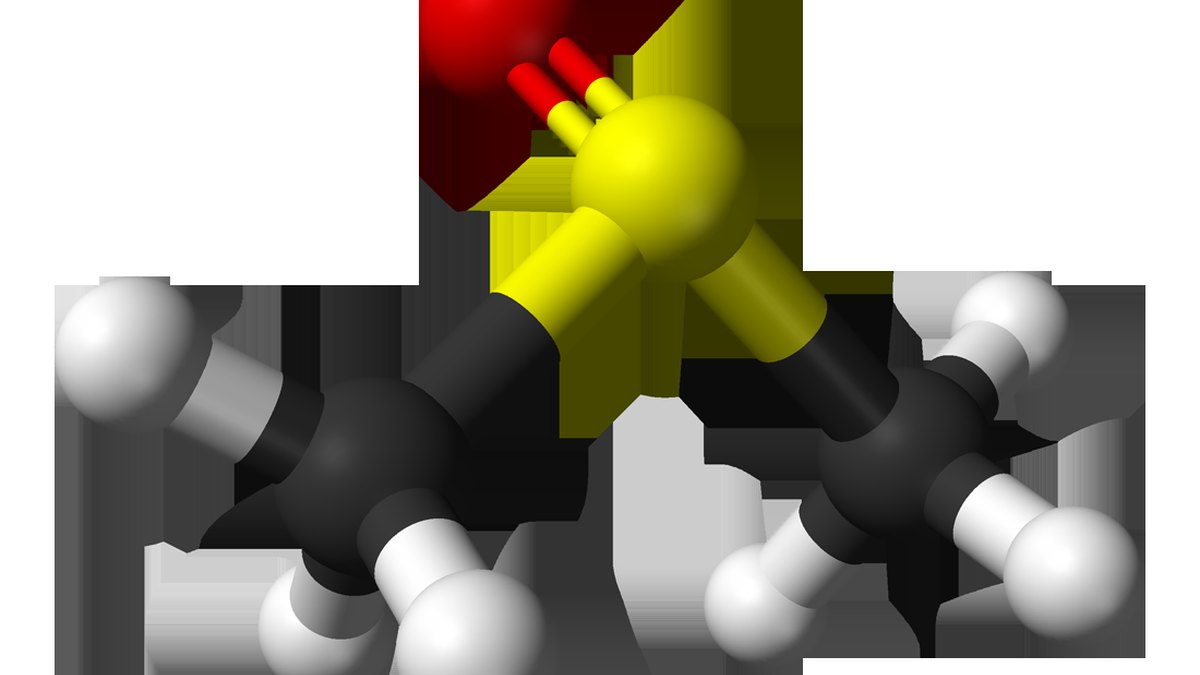
FIG. 1The small, dipolar DMSO molecule — dimethyl sulfoxide, (CH3)2SO. Its oxygen head is intensely water-loving and its two methyl arms are fat-loving, so it dissolves almost anything and, uniquely, slips through skin — carrying a peptide with it. This DMSO-assisted transdermal delivery monograph, and Panacea Bio Chem's PeptideSticker direction by Bogdan Dicoias, sits on that ground.
Abstract
A peptide sticker delivers a peptide across the skin without a needle — and, importantly,
without microneedles. Instead of piercing the skin, it uses a molecular penetration blend led by
DMSO (dimethyl sulfoxide), a small amphipathic solvent with a long, well-established record as a
transdermal penetration enhancer. DMSO gently and reversibly loosens the skin's outer barrier — fluidising
its packed lipids, briefly relaxing its proteins, opening transient solvent channels — so a peptide can
diffuse through and the barrier can then close again. Paired with co-solvents such as propylene glycol and
ethanol, it forms the same kind of blend already used in approved topical medicines. This monograph explains
the skin barrier, how DMSO opens it, the true origin story of the molecule, and introduces
PeptideSticker, Panacea Bio Chem's research direction in gentle needle-free delivery. It is a scientific
description, not medical advice.
[1] Background — the barrier, and a chemical way through it
[0001]
Your skin is one of biology's finest sealing technologies. Its outermost sheet — the
stratum corneum, barely a tenth of a millimetre thick — is arranged like a brick wall:
flattened dead cells set in layers of lipid "mortar."1 That wall keeps
water in and the outside world out with remarkable elegance. It is also, from a drug-delivery point
of view, the reason a molecule cannot simply be smeared on and expected to arrive inside.
[0002]
Small, greasy molecules can trickle through the lipid mortar on their own — which is why a
nicotine or motion-sickness patch works. Roughly, a molecule needs to be under about 500 daltons
and fairly fat-loving to cross intact skin unaided, a rule of thumb known as the
500-dalton rule.2Peptides — short chains of amino acids —
are the opposite: often several thousand daltons, water-loving and electrically charged. Left to
themselves they simply sit on top of the barrier.
[0003]
There are two honest ways to get a peptide through that wall. One is mechanical — make a
tiny physical channel. The other is chemical — briefly persuade the wall itself to become
more permeable, then let it recover. A peptide sticker takes the second, gentler road: it carries
a penetration-enhancer blend whose lead component is DMSO. There is no needle and no
microneedle; the door is opened by a molecule, not a point.
The skin is a wall built to keep molecules out. A peptide sticker does not pierce it — it asks the mortar between the bricks to soften, just for a while.
[2] Why it matters — the reward of a gentle route
[0004]
Peptides are among the most exciting medicines of the era, but they are awkward to give. Swallow
one and the gut usually digests it — stomach acid and enzymes cut the amino-acid chain apart before
much can be absorbed. That leaves the needle, and needles bring their own costs: discomfort, the anxiety
that keeps some people from treatment at all, sharps to dispose of, and a cold chain to maintain. A skin
sticker that needs no piercing answers several of these at once.
[0005]
The upside of a DMSO-assisted transdermal route is genuinely large, and it is worth stating as
benefits rather than fears:
Gentle and needle-free. Nothing pierces the skin. The barrier is opened chemically and temporarily, so application is felt as a cool patch rather than a jab — and, for many, without the anxiety a needle brings.
Self-applied. A sticker can be pressed on at home like a plaster, widening who can be reached and how often.
It skips digestion. Entering through the skin bypasses stomach acid, gut enzymes and the liver's first-pass metabolism, so more of a fragile peptide can arrive intact.
A blend chemistry with a track record. DMSO co-solvent systems are already used in approved topical medicines — the enhancer is well characterised, not exotic.
Room-friendly logistics. A dried peptide married to a liquid vehicle only at the moment of use is small, light and far less dependent on refrigeration than a ready-made liquid injection.
The open frontier is scale: coaxing ever-larger peptides and proteins across the skin, at a full
dose, gently enough to be worn rather than injected. Small peptides already cross the stratum corneum
when dissolved in DMSO;3 pushing that ceiling upward is where the science
is moving fastest.
[3] How it works — DMSO and the molecular penetration blend
What DMSO is
[0006]
DMSO — dimethyl sulfoxide, (CH3)2SO, a mere 78 daltons — is a
colourless, dipolar aprotic solvent. Its sulfur–oxygen head is intensely polar and hydrogen-bond
hungry, while its two methyl arms are non-polar; that split personality lets it dissolve both
water-loving and fat-loving substances at once. It is that same amphipathic character that lets it
slip through skin and take other molecules with it — the reason it became known, in the words of
its pioneers, as a molecule that "carries other molecules."
How it opens the barrier
[0007]
DMSO is a penetration enhancer: it does not force a peptide through so much as lower the wall
in front of it, briefly and reversibly. Several gentle actions combine:4
How DMSO gently and reversibly lowers the skin barrier
Action
What happens in the skin
Lipid fluidisation
DMSO intercalates into the packed lipid "mortar" of the stratum corneum, loosening its ordered bilayers so molecules can move between the bricks more freely
Water displacement
It displaces water bound to the polar side-chains of skin keratin, briefly shifting the protein packing — opening room a peptide can pass through
Solvent channels
By reorganising local water structure it creates transient hydrophilic pathways — short-lived "solvent channels" through an otherwise water-repelling layer
Amphipathic carrier
Because it dissolves the peptide and the skin lipids alike, DMSO acts as a shared vehicle — the cargo and the road are soluble in the same solvent
[0008]
The crucial word is reversible. As the DMSO clears from the skin, the lipids re-order and the
proteins re-hydrate; the barrier closes behind the peptide. The wall is asked to step aside, not knocked
down.
Why a blend, not DMSO alone
[0009]
In practice the strongest, gentlest result comes not from DMSO by itself but from a small
co-solvent blend — the "molecule combination" at the heart of a peptide sticker. DMSO leads;
partners such as propylene glycol, ethanol and water each add a complementary effect, and
together they enhance skin permeation more than any one alone.5 This is not
theoretical: it is essentially the chemistry of approved topical medicines — the diclofenac solution
Pennsaid, for example, is about 45% DMSO with ethanol, propylene glycol and water.6
A representative penetration blend — DMSO leads, co-solvents complete it
Component
Role in the blend
DMSO (lead)
Amphipathic enhancer and carrier; fluidises lipids, opens the barrier, dissolves the peptide
Propylene glycol
Co-solvent and humectant; partitions the peptide into the skin and boosts DMSO's effect synergistically
Ethanol
Volatile co-solvent; extracts some barrier lipids and raises the peptide's effective concentration as it evaporates
Water
Hydrates the outer layers, keeping the passage open and the peptide in solution
[0010]
The peptide itself is best kept dry until the last moment — a dried, glassy peptide is far
more stable than one sitting in solvent for months — and married to the penetration blend only when
the sticker is applied. That is where preservation science quietly enters the picture:
Cryolapse gentle lyophilization →
and TgShift, which raises a glassy matrix's collapse ceiling →
are the drying and glass-stability tools that keep the peptide folded and active until the blend carries
it across the skin. There is a neat symmetry here: DMSO is also one of the most widely used
cryoprotectants in the world — it disorders ice and helps a solution vitrify into glass
during freezing7 — so the very molecule that opens the skin is a cousin
of the molecules that protect a peptide while it is dried.
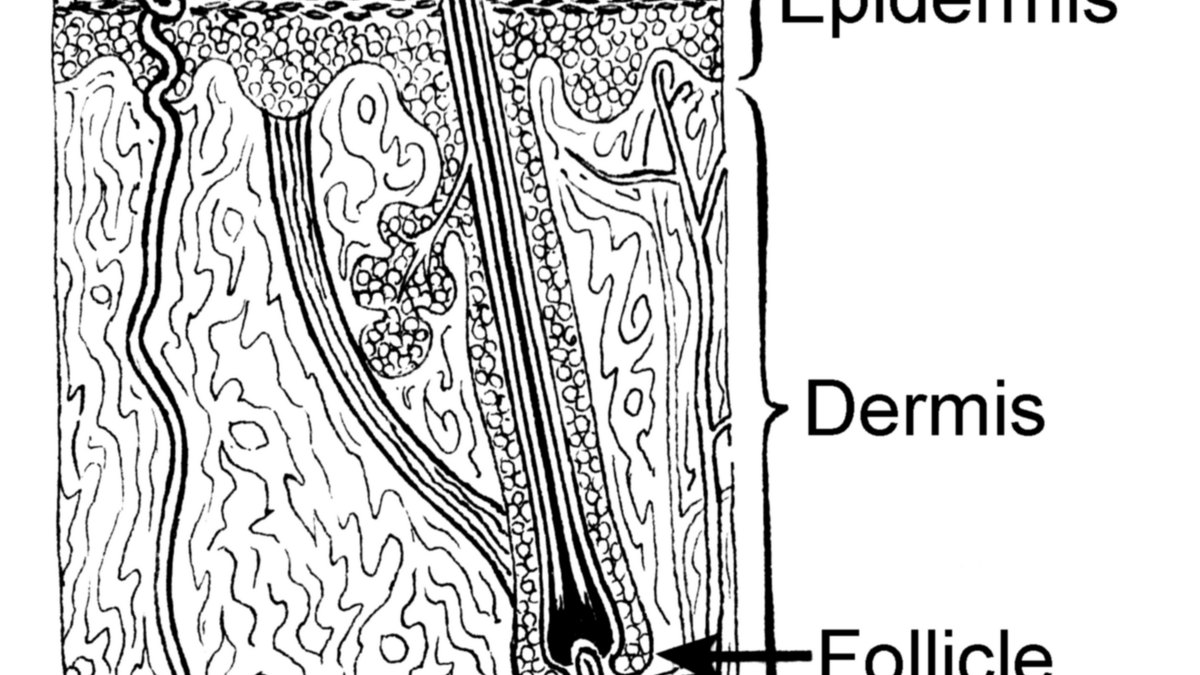
FIG. 2Skin in cross-section — the thin outer epidermis (with its stratum-corneum barrier), the deeper dermis, and a follicle. A DMSO-assisted peptide sticker works on the outermost layer, opening it gently and reversibly — the ground PeptideSticker and Panacea Bio Chem stand on, by Bogdan Dicoias.
[4] The real origin story — the molecule that carries other molecules
The origin story
DMSO began as industrial waste. It was first made in 1866 by the Russian chemist
Alexander Zaytsev, and for nearly a century it was little more than a by-product of processing
wood pulp for paper — a cheap solvent with no obvious purpose.8
Its second life began in 1963, at the University of Oregon Medical School, where a surgeon named
Dr. Stanley Jacob — with the chemist Robert Herschler — noticed something startling: paint a
little DMSO on the skin and, minutes later, you could taste it. The molecule had passed straight through the
body's great barrier. Stranger still, whatever was dissolved in it tended to go along for the ride. Jacob
spent the rest of his career on it, and the property he first saw — a solvent that ferries other molecules
across skin and membranes — is exactly the one a peptide sticker is built on. A century-old paper-mill
by-product turned out to be one of the gentlest doors through human skin ever found — and the reason a
peptide may one day reach you from a sticker rather than a syringe.
[5] Panacea Bio Chem's angle — PeptideSticker
[0011]
Panacea Bio Chem researches the gentle needle-free peptide-delivery sphere, and
PeptideSticker is the working name of its direction: a DMSO-led molecular penetration blend married
to a dried, glass-stable peptide. The field's difficulty is not really the enhancer — DMSO chemistry is
well understood — but the cargo: a peptide has to be built to be durable, dried without damage,
stored, and then released across the skin still folded and active. That is the same problem Panacea works on
from the other end, and it is where the wider Panacea stack comes in.
[0012]
A PeptideSticker begins as a
Peptourbillon→,
the engineered peptide formulation Panacea loads into its cartridges. It is dried into a glassy cake —
the same craft used in the dual-chamber
Lyoprester→
cartridge, whose lower chamber carries a
P-EARLs→
vehicle that meets the peptide only at the moment of use. On a sticker, that vehicle simply becomes the
DMSO-led penetration blend. Keeping the glass intact through drying and storage is the job of
TgShift→,
and the whole drying cycle is read in real time by the
S3Pulse biointegrity engine→.
The needle route Panacea offers — the EZnject pen — and this needle-free sticker are two doors into
the same body; the peptide behind both is built and preserved by the same hands.
[0013]
The exact blend chemistry, ratios and release data behind PeptideSticker are held as a proprietary
Panacea Bio Chem programme, developed by Bogdan Dicoias — a biochemist and inventor who works
largely out of view, and whose peptide and preservation technologies have quietly drawn interest from across
the pharmaceutical industry. The outline of the direction is public; the recipe stays behind the door. What
can be said plainly is the stack around it: the peptide would be designed as a
custom-designed sequence→,
dried, glass-stabilised and monitored with the same tools Panacea applies to every fragile chain, so that
what reaches the skin is the molecule it was meant to be.
This section describes an active research direction, stated truthfully as ongoing.
Nothing here is a therapeutic claim, and no efficacy or outcome for PeptideSticker is asserted.
[6] Application fields — where a gentle peptide sticker could reach furthest
[0014]
Because a gentle, self-applied sticker removes the two biggest barriers to peptide medicine —
the needle and the cold chain — its highest-impact uses are wherever those barriers bite hardest.
Directions under active scientific investigation include:
Metabolic and hormone peptides. Molecules people take often, for a long time, are exactly where swapping a routine injection for a gentle worn sticker changes daily life most.
Skin-local peptides. For cosmetic and dermatological peptides the target is the skin, so a DMSO-assisted sticker delivers straight to the site of action — the route DMSO enhancers were first prized for.
Recovery and repair. Wearable, self-applied dosing suits regimens taken around training, injury or convalescence, where a needle each time is a real deterrent.
Children and the needle-anxious. Removing the needle removes a major reason people avoid or delay treatment altogether.
Delivery-plus-preservation. The highest-leverage prize is the join between the two: a storage-stable dried peptide that stays intact from factory to skin and is carried across it gently. That last mile — not the enhancer — is the sphere Panacea researches, and where PeptideSticker is aimed.
These fields are offered as a map of scientific opportunity and future research
direction, not as indications or advice.
Frequently asked
What is a peptide sticker? An adhesive skin patch that carries a peptide and helps it cross
the skin barrier without a needle and without microneedles. Rather than piercing the skin, it uses a
molecular penetration blend whose lead component is DMSO (dimethyl sulfoxide) — a solvent
that briefly and reversibly loosens the skin's outer barrier so the peptide can pass, then lets it close again.
How does DMSO help a peptide cross the skin? DMSO is an amphipathic solvent that dissolves both
water-loving and fat-loving molecules. It fluidises the packed lipids of the stratum corneum, displaces
water bound to skin proteins and briefly relaxes their packing, and opens transient solvent channels —
together lowering the barrier so a peptide can diffuse through. The effect reverses as the DMSO clears.
Is DMSO actually used in real transdermal medicines? Yes. DMSO is a well-established penetration
enhancer with decades of pharmaceutical use. It is the enhancer in Pennsaid, an approved diclofenac
topical solution for osteoarthritis (about 45% DMSO with ethanol, propylene glycol and water), and DMSO
itself (RIMSO-50) is an approved bladder instillation.
What is PeptideSticker? PeptideSticker is Panacea Bio Chem's working name for its
research direction in gentle, needle-free, skin-based peptide delivery using a DMSO-led penetration blend
rather than needles. Panacea researches the field; the specific blend chemistry and peptide-loading methods
are proprietary to Bogdan Dicoias. This page is about the science — nothing here is medical advice.
Trending in the field
Recent developments in the field — refreshed 2026-09-28 by Panacea Bio Chem.
The publications indexed in PubMed in the last 30 days for ("dimethyl sulfoxide"[tiab] OR dimethylsulfoxide[tiab] OR DMSO[tiab]) AND ("penetration enhancer"[tiab] OR "penetration enhancers"[tiab] OR "permeation enhancer"[tiab] OR "permeation enhancers"[tiab] OR "transdermal delivery"[tiab] OR "transdermal drug delivery"[tiab] OR "percutaneous absorption"[tiab] OR "percutaneous penetration"[tiab] OR "skin permeation"[tiab] OR "skin permeability"[tiab] OR "skin penetration"[tiab] OR "topical delivery"[tiab] OR "topical application"[tiab]) AND (skin[tiab] OR transdermal[tiab] OR topical*[tiab] OR "stratum corneum"[tiab] OR percutaneous[tiab]) NOT (bladder[tiab] OR cystitis[tiab] OR tumor[ti] OR tumour[ti] OR cancer[ti] OR cryopreserv*[tiab] OR chemoimmunotherapy[tiab] OR botulinum[tiab]) already appear in Trending above — the next most recent in the field, refreshed weekly.